
Low Stimulation Shows for Babies: An Honest Guide

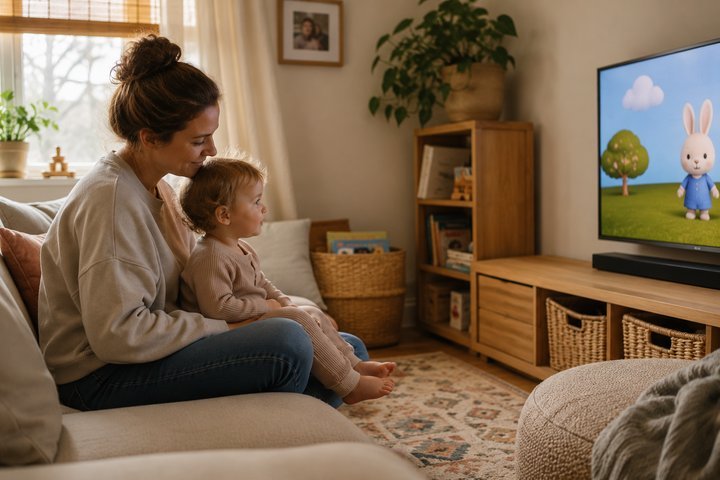
Sometimes you don’t need a parenting philosophy. You need both arms free for ten minutes.
Breakfast is burning. The baby wants to be held. You type “low stimulation shows for babies” because if you’re putting something on, you at least want the calmest thing you can find.
Fair.
There is real screen guidance for this age, and it matters. There is also real life.
So here’s the honest version: what current guidance says, why 18 months matters, and the handful of shows I’d actually consider once your child is old enough for high-quality, shared screen time.
What does the guidance actually say about screens before and after 18 months?
Current American Academy of Pediatrics guidance is clear: before 18 months, avoid screen media apart from live video chatting.
That recommendation still stands.
The AAP’s 2026 update changed how it talks about screen use more broadly. There is now more emphasis on content, context, co-viewing, and what screens replace during the day. It did not remove the under-18-month guidance.
The reason is pretty simple. Babies this young learn best through real back-and-forth with another person. Faces, voices, pointing, touching, copying, babbling back at you. A screen doesn’t replace that exchange.
From 18 to 24 months, the guidance opens up. If you introduce media, choose high-quality content and watch it together.
And drop the idea that everybody else is somehow managing this perfectly.
A 2025 Lurie Children’s survey found that 49% of parents rely on screens every day to help manage parenting responsibilities.
You are not the strange exception hiding in the kitchen with Puffin Rock on.
The fifteen minutes of TV isn’t the thing shaping your baby’s whole childhood.
The thousand other minutes matter too.
If you’re worried about your own baby’s development or screen use, ask your pediatrician.
What should babies under 18 months watch?
The honest short answer is: no show is the better choice here.
If you need ten minutes with your hands free, a few safe objects in the high chair, a floor mirror, a kitchen drawer they’re allowed to empty, or a basket full of washcloths buys surprising mileage.
Babies have an impressive ability to ignore the expensive activity and become deeply committed to removing twelve socks from a container.
For more ideas like that, use baby activities month by month. That’s the screen-free baby activity guide, and it is the more useful answer for this age.
If a screen happens anyway, keep it short and stay nearby.
A slow video with a real face and simple sound is easier to share than frantic animation. Live video chatting with Grandma or another familiar person is the screen use current guidance specifically makes room for because real back-and-forth is happening.
Then move on with your day.
No guilt ceremony required.
What are the best low stimulation shows for babies 18 to 24 months?
Once you’re in the 18-to-24-month window and introducing media, I want slow pictures, gentle sound, simple stories, and room for you to talk along.
Not every show below was made specifically for an 18-month-old. That’s why the age-fit line matters.
Puffin Rock
Where to watch: Netflix in the US.
Age fit: One of the easiest picks to try around 18–24 months with you beside them.
Why it’s calm: Long shots, soft narration, animals, nature, and very little visual clutter. The story doesn’t panic if nothing exciting happens for five seconds.
Anita note: Start here. I’ve seen young toddlers actually look around the screen and notice the bird, the water, the rocks. They aren’t just staring at motion.
Little Bear
Where to watch: Paramount+ in the US.
Age fit: 18–24 months for simple co-viewing. The stories make more sense as they get older.
Why it’s calm: Warm voices, hand-drawn animation, everyday play, and gloriously little urgency.
Anita note: This is what I mean when I say slow TV. Little Bear can spend time walking through the woods without a siren, confetti cannon, or alphabet appearing over his head.
Miffy’s Adventures Big and Small
Where to watch: Prime Video in the US.
Age fit: A good visual fit for younger toddlers because the world is so simple.
Why it’s calm: Clean backgrounds, familiar objects, plain shapes, and stories about very small things. You have time to say “ball” before the ball disappears.
Sarah & Duck
Where to watch: Prime Video in the US.
Age fit: The stories are written for older kids, but the pace works well for younger toddlers watching with you.
Why it’s calm: Quiet narration, dry little jokes, simple animation, and stretches where nobody feels required to yell.
Trash Truck
Where to watch: Netflix in the US.
Age fit: Better as your child moves toward 2, especially if trucks are already fascinating.
Why it’s calm: Soft-looking animation, simple friendship stories, and slower movement than most vehicle shows.
Good to know: A truck-loving toddler can make anything stimulating. If garbage day already causes stadium-level excitement at your house, watch the reaction.
Tumble Leaf
Where to watch: Prime Video in the US.
Age fit: Made for preschoolers, but easy to co-view with a younger toddler.
Why it’s calm: Stop-motion animation, tactile objects, nature, and simple exploration. The show actually spends time looking at the thing it is talking about.
Mister Rogers’ Neighborhood
Where to watch: Free on Mister Rogers’ official YouTube channel, and free with ads on Pluto TV, in the US.
Age fit: The concepts grow with your child, but the pace is excellent for a young viewer.
Why it’s calm: A real human voice. Long pauses. Real objects. Real places. Fred Rogers waits for children to process what he just said.
Anita note: If modern kids’ TV has rewired your expectations, Mister Rogers feels almost suspiciously quiet at first. Give it five minutes. That’s the point.
Daniel Tiger’s Neighborhood
Where to watch: PBS KIDS in the US.
Age fit: Better near 2 and beyond, but useful for short co-viewed clips earlier.
Why it’s calm: Clear stories about feelings and routines, repeated phrases, and less frantic editing than most modern preschool TV.
Good to know: It’s more musical and visually busy than Puffin Rock, Little Bear, or Mister Rogers. I wouldn’t make it the first low-stim pick for a very young toddler.
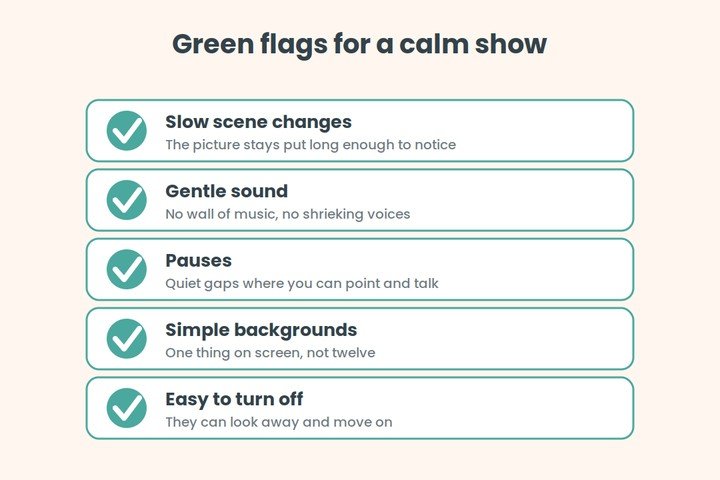
How can you tell if a show is too stimulating for your baby?
Forget the “educational” label for a minute.
Watch what the show actually does.
Count the cuts. If the picture changes every couple of seconds, your baby never gets much time to inspect what they just saw.
Listen to the sound. Constant music, high-pitched voices, sound effects, and zero quiet space make a show feel much busier.
Watch your baby, not just the TV. Calm interest looks different from being completely locked onto a screen. A baby staring without moving isn’t automatically relaxed.
Pay attention when it ends. This is my favorite test. If turning off the same show creates a huge fight every single time, change something. Try a calmer show, a shorter session, or both.
Look for actual space. One person talking. One object on screen. A pause after a question. Those boring little gaps are useful.
That is why CoComelon doesn’t make my calm list.
There is no research showing CoComelon itself harms toddler development. That’s important to say plainly.
The fair criticism is its fast pacing, bright presentation, constant movement, and shallower learning experience compared with calmer options.
You don’t need to call it poison to decide it isn’t what you want at 7 a.m.
Ms. Rachel is a different case.
There is no published research proving that Ms. Rachel videos improve development.
What her videos do have is clear learning goals, repetition, pauses that give a child time to respond, fewer distracting extras, and lots of direct-to-camera interaction.
That’s useful.
I’ve also seen the other side of it: a toddler who loves one familiar person on screen can become very committed to that person staying on screen.
So watch your child.
The best low stimulation show is one they can enjoy and then leave.
How do you make screen time count?
Watch with them when you can.
That’s co-viewing. Point at things. Name them. Repeat a word from the show. Connect it to something your child knows.
“Duck. We saw ducks at the pond.”
Then keep it short enough that you stop before everybody is exhausted.
A screen works better as one small thing you did together than as the thing filling the afternoon.
FAQ
Can babies under 1 watch TV?
Current AAP guidance says to avoid screen media before 18 months except live video chatting.
Babies this young learn much more from real faces, voices, touch, play, and back-and-forth interaction.
If ten minutes of TV happens while you make breakfast, make the next choice when breakfast is done.
What is the most calming show for babies?
For an 18-to-24-month-old, I’d start with Puffin Rock or Little Bear.
Both move slowly, sound gentle, and give you plenty of time to point and talk while you watch.
Is CoComelon bad for babies?
There is no research showing that CoComelon itself harms toddler development.
The reason it doesn’t make this low-stimulation list is simpler: its fast pacing, bright visuals, constant music, and frequent scene changes make it much busier than the shows above.
If your goal is calm, choose something slower.
Is Ms. Rachel okay for babies?
Ms. Rachel uses several features associated with better learning from media, but there is no published research proving her videos improve a baby’s development.
Her videos use repetition, clear learning goals, pauses for responses, and direct interaction.
For very young children, watching and responding together matters more than treating the video as a lesson they should watch alone.
The bottom line
Ten minutes of a calm show so you can eat breakfast is not the thing that shapes your baby.
Be thoughtful, keep real life bigger than the screen, and move on.
When your child is older, low-stimulation shows for toddlers has our full guide to low stimulation shows for toddlers.