
Baby Activities Month by Month (0 to 12 Months)

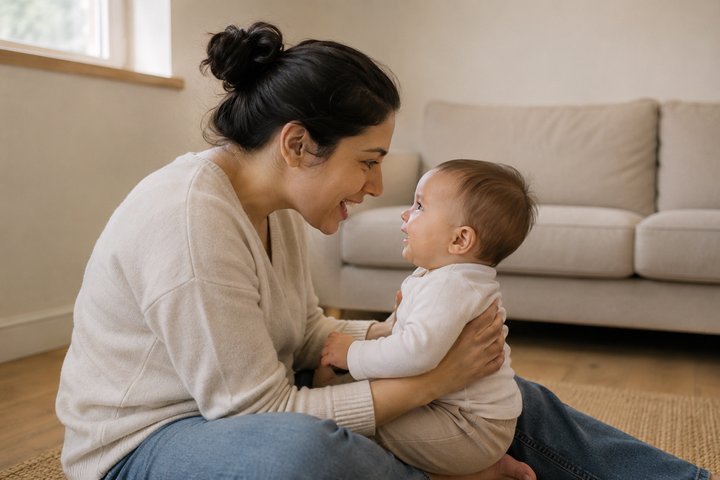
If you’re worried you’re not doing enough with your baby, here’s the part I want you to hear first: you do not need to keep a baby entertained all day.
Your face matters. Your voice matters. Holding them, answering their little noises, walking around the house together, and letting them watch you are already the main event.
Milestone charts and developmental-toy ads have made ordinary baby care look suspiciously inadequate. It isn’t.
Some days are still very long, though. So here are simple, safe baby activities for each stage of the first year. No flashcards. No special gear. No activity schedule.
Do babies even need activities?
Not in the way the internet makes it sound.
Babies learn all day. They hear you talking while you change a diaper. They stare at your face while you hold them. They grab your finger. They watch light move across the wall. They make a noise, you answer, and they do it again.
Being responsive to your baby supports early learning and connection. There isn’t one magic activity that makes or breaks development.
The activities on this page are low-stakes. They give you something simple to try when you’ve already walked around the same three rooms six times before lunch.
Babies develop on their own timeline. If anything about your baby’s development worries you, your pediatrician is the person to ask, not a chart or a blog.
What matters at every stage?
Talk to your baby.
Put your face where they can see it. Answer their coos. Pause when they make a sound and give them a chance to answer you again. Narrate the boring stuff: “I’m putting your sock on. Here’s the other sock.”
People sometimes call this “serve and return.” Your baby makes a sound, look, or movement, and you respond. They start learning that what they do gets a response from another person.
You don’t need cards, an app, or a lesson plan for that.
Everything below is extra.
Baby activities from 0 to 3 months
A newborn has a very small agenda: eat, sleep, be held, and stare at things from very close range.
Newborn vision works best roughly 8 to 12 inches away. Conveniently, that’s about the distance between your baby’s face and yours when you’re holding them.
This is not the stage to build an activity schedule. One tiny thing during a calm awake stretch is plenty.
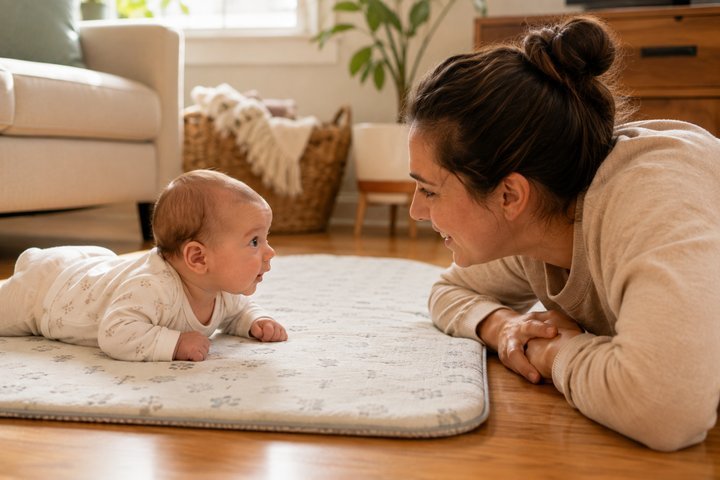
1. Face-to-face talking
Tags: 5 min · No prep
You’ll need: You
What to do: Hold your baby comfortably or lie beside them on the floor while they’re awake. Put your face close enough for them to see and talk normally.
Pause every few sentences. A newborn won’t hold a conversation, obviously, but you will start seeing tiny changes in their face when they hear you.
What it’s building: Familiarity with voices, faces, and the back-and-forth rhythm of communication.
2. Homemade high-contrast pictures
Tags: 5 min
You’ll need: White paper and a thick black marker
What to do: Draw one big, simple shape on each sheet: thick stripes, a circle, or a checkerboard. Hold one picture near your baby’s line of sight while they’re awake.
Move it slowly if they’re looking at it. Stop when they look away.
Safety: Hold the paper yourself. Don’t leave loose paper or cards in a crib, bassinet, or other sleep space.
What it’s building: Giving young eyes something simple and high-contrast to look at. High-contrast patterns are easier for newborns to see than fine detail.
3. Tiny tummy-time visit
Tags: 5 min · No prep
You’ll need: A clear spot on the floor
What to do: Put your awake baby on their tummy on a firm floor surface and get down beside them. Talk, sing, or put your face where they can see you.
If they fuss quickly, pick them up and try again another time. I’ve known babies who treat thirty seconds of tummy time like a formal complaint.
Safety: Tummy time is for awake, supervised play only. Stay with your baby the whole time, and never use tummy time as a sleep position.
What it’s building: Time on the tummy gives babies a chance to work the neck, shoulder, and upper-body muscles they use during movement.
4. Sing, then pause
Tags: 5 min · No prep
You’ll need: Your voice
What to do: Sing any short song you know. Your baby does not care whether you are good at singing.
Pause before the last word or sound and watch their face. The pause itself makes the interaction feel different from a constant stream of noise.
What it’s building: Listening and the early rhythm of back-and-forth interaction.
5. Slow house tour
Tags: No prep
You’ll need: Nothing
What to do: Hold your baby securely and walk around one room. Stop at a bright window, a picture on the wall, or another clear visual contrast and tell them what you’re looking at.
You do not need to tour the whole house. Newborn entertainment has a very low production budget.
Safety: Keep a secure hold on your baby and stay away from hot surfaces, cooking areas, and anything hanging within reach.
What it’s building: New sights, voices, and gentle changes in position during ordinary time with you.
6. Washcloth touch
Tags: 5 min · No prep
You’ll need: One clean, soft washcloth
What to do: While your baby is awake and you’re holding or sitting beside them, lightly touch the washcloth to a hand, foot, or leg. Talk about what you’re doing.
There is no need for a basket of twelve textures. One washcloth is enough.
Safety: You hold the fabric. Keep it away from your baby’s face and neck, and never leave loose fabric in a sleep space.
What it’s building: A simple chance to notice touch and different sensations.
If you only try one: Talk to them. Your face and voice are already interesting to a newborn, and the activity requires exactly zero setup.
Baby activities from 3 to 6 months
Now play gets more obvious. Babies start reaching toward things, bringing everything toward the mouth, and becoming much more interested in social back-and-forth.
This is also the age when you set something beside them and discover the real activity was trying to eat it.
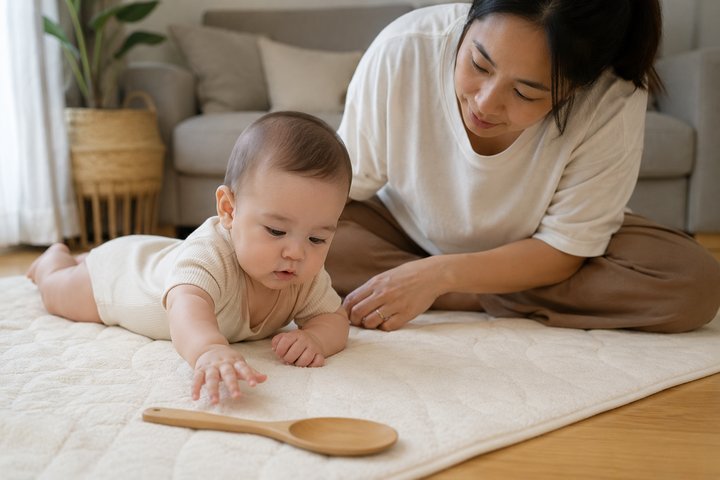
7. Reach for one thing
Tags: 5 min · No prep
You’ll need: One large, lightweight household object, such as a wooden spoon
What to do: Put your baby on the floor during awake play and hold the object where they can see it. Bring it close enough that reaching feels possible.
Let them grab, hold, and inspect it instead of waving five toys around at once.
Safety: Babies mouth objects at this age. Use one solid piece with no loose parts, sharp edges, batteries, magnets, or choking-size pieces. Stay right there.
What it’s building: Reaching, grasping, and coordinating what the eyes see with what the hands do.
8. Big-texture basket
Tags: 5 min · Rainy day
You’ll need: A shallow basket with three large items, such as a washcloth, silicone spatula, and wooden spoon
What to do: Sit with your baby on the floor and offer one object at a time. Let them grip it, turn it, rub it, and explore it.
Three things are plenty. A giant sensory basket mostly gives you nine extra things to pick up.
Safety: Every object needs to be too large to choke on and safe to mouth. Keep fabric short and away from the face and neck. Supervise the whole activity.
What it’s building: Grasping and noticing that objects feel different.
9. Mirror conversation
Tags: 5 min · No prep · Rainy day
You’ll need: A baby-safe, shatter-resistant mirror
What to do: Sit with your baby in front of the mirror. Point to their reflection, then yours. Smile, make a face, and talk.
Do not worry about teaching “self-recognition.” Looking together is enough.
Safety: Use only a baby-safe, shatter-resistant mirror and keep it stable during play.
What it’s building: Face watching, social attention, and lots of opportunities for you to talk together.
10. Hands-only peekaboo
Tags: 5 min · No prep
You’ll need: Nothing
What to do: Cover your own face with your hands, pause, then open them and say hello.
Keep your hands on your face, not your baby’s. Once they know what’s coming, that tiny pause before you reappear is half the game.
What it’s building: Attention, anticipation, and early understanding that people are still there when briefly hidden.
11. Tummy time with your face
Tags: 5 min · No prep
You’ll need: A clear floor space
What to do: Put your awake baby on their tummy and lie down in front of them. Talk, smile, or make one quiet sound.
I’ve watched babies reject every strategically placed toy and then lift their head because somebody got down on the floor and made a ridiculous face. Use the free equipment first.
Safety: Tummy time stays on a safe floor surface, awake and directly supervised. Never leave your baby alone during it.
What it’s building: Upper-body movement plus face-to-face interaction.
12. Song with simple motions
Tags: 5 min · No prep
You’ll need: Your voice
What to do: Sing a short familiar song while gently moving your own hands or clapping. Let your baby watch.
If they’re reaching for your hands, slow down and give them a chance to touch them.
Safety: Keep motions gentle. Don’t pull a baby’s arms, force stretches, or move their joints through a routine.
What it’s building: Watching movement, listening to repeated sounds, and joining a social routine.
If you only try one: Get face-to-face on the floor. At this age, your face still beats a remarkable amount of baby equipment.
Baby activities from 6 to 9 months
The floor gets busier now. Sitting, reaching, banging, dropping, and figuring out what happens when an object disappears give you much more to work with.
The dropping is not an accident, by the way. Pick it up once and you’ve apparently signed a contract.
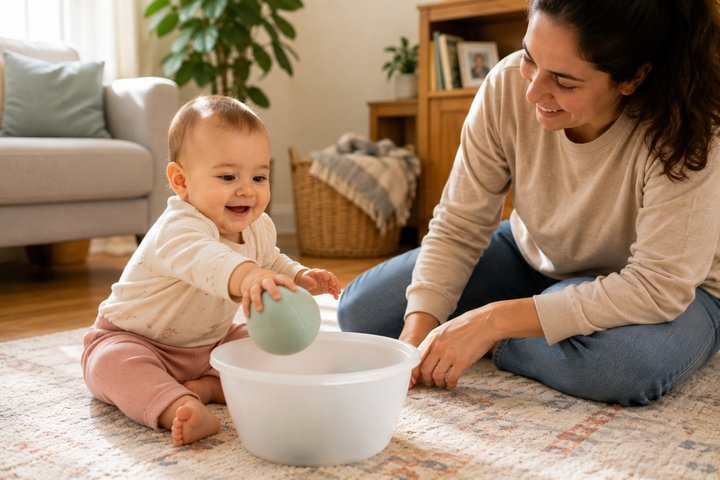
13. Big bowl in-and-out
Tags: 5 min · No prep · Rainy day
You’ll need: A large plastic bowl and three large plastic cups
What to do: Put one cup into the bowl and take it back out. Hand the bowl and cups to your baby and let them work out the rest.
They’ll put things in, pull them out, bang them together, and possibly ignore the bowl completely for a while.
Safety: Use large, lightweight items with no loose pieces. Everything needs to be safe for mouthing. Supervise play on the floor.
What it’s building: Grasping, releasing, and seeing how objects fit inside other objects.
14. Drop it in
Tags: 5 min · Rainy day
You’ll need: A wide plastic container and one large soft ball
What to do: Drop the ball into the container, then tip it back out. Give the ball to your baby.
Keep the opening wide. This is about the satisfying drop, not getting a tiny object through a difficult hole.
Safety: The ball must be much too large to choke on. Stay beside your baby during play.
What it’s building: Releasing an object on purpose and seeing an immediate result.
15. Kitchen percussion
Tags: 5 min · No prep · Rainy day
You’ll need: A wooden spoon and two lightweight plastic containers
What to do: Tap one container with the spoon, then the other. Hand the spoon over.
Do not provide the entire cookware cabinet unless you have made peace with the consequences.
Safety: Use lightweight, unbreakable objects with no loose pieces. Supervise because the spoon will also be chewed.
What it’s building: Cause and effect, two-handed play, and noticing different sounds.
16. Roll the ball back
Tags: 5 min · No prep
You’ll need: One large soft ball
What to do: Sit on the floor facing your baby and roll the ball slowly toward them. Help stop it the first time, then roll it again.
If the ball never comes back to you, welcome to playing ball with a baby.
Safety: Use a soft ball too large to fit in the mouth and keep the game on the floor.
What it’s building: Visual tracking and the first shape of a back-and-forth game.
17. Where did it go?
Tags: 5 min · Rainy day
You’ll need: A large toy and an upside-down plastic cup or bowl
What to do: Let your baby see the toy, then hide part of it under the bowl. Reveal it.
Once that feels familiar, cover it completely and let your baby reach for the bowl. This plays with object permanence, which simply means learning that something still exists when you can’t see it.
Safety: Use only large objects that are safe to mouth. Stay with your baby during the game.
What it’s building: Memory and understanding that hidden objects have not vanished.
18. One-board-book read
Tags: 5 min · No prep · Rainy day
You’ll need: One sturdy board book
What to do: Sit together and look through the book. Name whatever your baby looks at instead of trying to finish every sentence on every page.
Let them grab the book, slap the page, close it early, and reopen it.
Safety: Use a sturdy book in good condition with no loose paper or torn pieces.
What it’s building: Shared attention, listening to words, and handling a book.
If you only try one: Put a big bowl and three cups on the floor. Babies this age get a lot of mileage out of putting things somewhere and immediately undoing their own work.
Baby activities from 9 to 12 months
This is the stage where your house becomes the activity.
Older babies pull up, move toward what interests them, copy simple actions, and start using gestures such as pointing as communication develops.
Give them safe ways to move, put things somewhere, knock things over, and copy what you do.
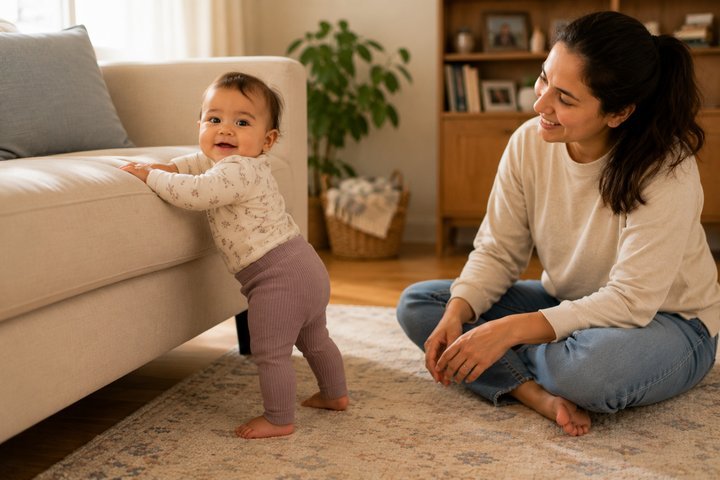
19. Couch-side cruising game
Tags: Burn energy
You’ll need: A stable couch and one favorite large toy
What to do: If your baby is already pulling to stand and moving along furniture, put the toy a short distance along a stable couch so they have a reason to move toward it.
Keep the distance tiny. This is not a walking lesson.
Safety: Only use this with a baby already pulling up on their own. Stay within arm’s reach, keep the floor clear, and never set this up on raised furniture or near stairs.
What it’s building: Practice shifting weight and moving sideways while holding a stable support.
20. Washcloth posting
Tags: 5 min · Rainy day
You’ll need: A wide plastic container and three short washcloths
What to do: Push one washcloth into the open container, leaving plenty showing. Let your baby pull it out and push it back in.
Skip a tight slot. At this stage, a big opening works perfectly well.
Safety: Use short washcloths only. Supervise closely, keep fabric away from the face and neck, and never put loose fabric into a crib or sleep space.
What it’s building: Two-handed coordination and working out how an object goes into a container.
21. Stack it, knock it
Tags: Busy solo · 5 min · Rainy day
You’ll need: Three or four lightweight plastic cups
What to do: Stack two cups while your baby watches. Let them knock the tower over.
Then put the cups within reach and let them bang, nest, stack, or knock them down while you stay nearby.
Safety: Use lightweight, unbreakable cups with no small detachable pieces. This is supervised floor play, even with the Busy solo tag.
What it’s building: Hand control and seeing how one action changes a simple structure.
22. Hello on the pretend phone
Tags: 5 min · No prep · Rainy day
You’ll need: A large safe object such as a wooden spoon, or an old phone with the battery and loose parts removed
What to do: Hold the object near your ear and say, “Hello.” Hand it to your baby.
They might copy you immediately. They might chew it. Both outcomes are very on-brand for 10 months.
Safety: Don’t use an active phone or anything with accessible batteries, buttons, loose pieces, or a cord.
What it’s building: Imitation and learning that actions can carry social meaning.
23. Point-and-name tour
Tags: 5 min · No prep
You’ll need: Nothing
What to do: Sit by a window or move around one familiar room with your baby. Point to one thing at a time and name it: dog, light, cup, tree.
If your baby points, follow their point and name what they’re showing you.
What it’s building: Connecting gestures, attention, and words during real interaction.
24. Fill and push the laundry basket
Tags: Busy solo · No prep · Burn energy
You’ll need: A sturdy laundry basket and two or three light towels
What to do: Put the towels beside an empty basket and show your baby how to drop one in. If they’re already standing and pushing stable objects, let them push the basket a short distance across a clear floor while you stay right beside them.
The towels will not remain folded. This was never really about laundry.
Safety: Keep the basket light, the floor clear, and stay within arm’s reach. Don’t use it near stairs or on a surface where it can tip or roll away quickly.
What it’s building: Copying a household action, carrying objects, and big-body movement.
If you only try one: Give them cups and a container. Putting things in, taking them out, stacking them, and knocking them over covers an impressive amount of baby entertainment with almost no setup.
As your baby moves into the next stage, activities for 1 year olds has activities built specifically for 1-year-olds.
What do you actually need for baby play?
Start with the free things:
- Your face
- Your voice
- Your hands
- Floor space
- A window to look out of
Then add a very small handful of useful things:
- A baby-safe, shatter-resistant mirror
- Sturdy board books
- Large plastic cups and containers
- A wooden spoon
- A few short washcloths
- One large soft ball
- Paper and a black marker for simple high-contrast pictures
That’s enough.
Baby toys still need the same basic safety check as household objects: no choking-size pieces, accessible magnets, button batteries, sharp edges, long cords, or damaged parts.
And none of the play materials on this page belong in your baby’s sleep space. Keep toys, loose fabric, and other soft objects out of cribs and bassinets.
You don’t need the developmental toy from the ad.
Frequently asked questions
Do babies need activities to develop?
No. Babies learn through everyday interaction, including being held, talked to, looked at, responded to, and given safe opportunities to move and explore.
Activities are an extra way to spend time together. Responsive interaction is the important part.
How much tummy time does a baby need?
Common guidance is to offer tummy time in short stretches while your baby is awake and supervised, then build up as they tolerate it.
Keep tummy time on a firm floor surface and stay with your baby. For advice about the right amount for your individual baby, especially if they were premature or have a medical concern, ask your pediatrician.
What are the best activities for a newborn?
Talking face-to-face, looking at simple high-contrast patterns, singing, being carried around the room, and short supervised tummy-time sessions are plenty for a newborn.
Keep everything close, simple, and brief. Newborns see best at about 8 to 12 inches, which happens to put your face in excellent viewing range when you’re holding them.
Am I doing enough with my baby?
Almost certainly, yes.
If you’re holding your baby, talking to them, responding when they make sounds, giving them safe time to move, and taking care of their everyday needs, you’re already providing the interaction babies learn from.
You do not need to fill every awake minute with stimulation.
Your baby already has their favorite activity
Most days, the best thing you do for your baby is simply be with them.
When toddlerhood arrives, toddler activities: 45 ideas by age has the wider toddler activity guide and activities for 1 year olds picks up at age 1.
You can also join the email list for the printable play pack.