
Activities for 1 Year Olds: What Actually Works

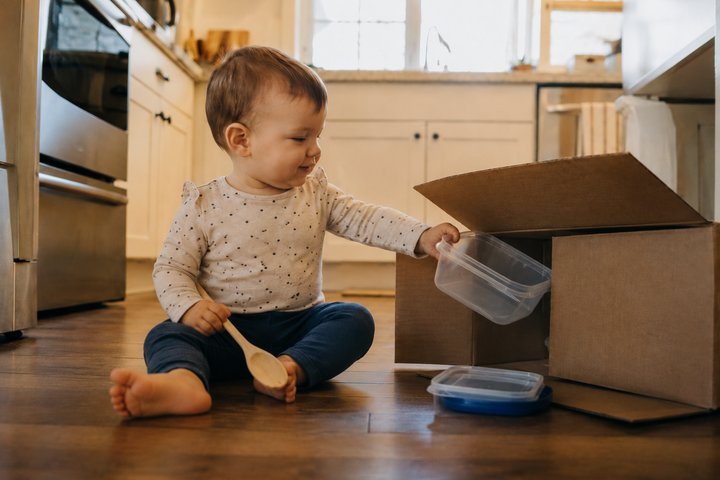
Your 1-year-old is mobile, nearly mobile, and suddenly very interested in everything you hoped they wouldn’t notice. Nothing holds their attention for long. They’d rather empty your kitchen drawer than play with the toy you bought for exactly this stage.
You don’t have to plan structured activities for a 1-year-old. Free play and following you around the house count.
But the days are long. So here are 25 screen-free activities that actually work with ordinary stuff from around the house, split by age because a 13-month-old and a 22-month-old are not looking for the same kind of play.
Why do we split activities for 1 year olds by age?
At 12 to 17 months, a lot of play happens close to the floor. This is the age of crawling, cruising, first steps, dropping things into containers, and immediately dumping them back out.
By 18 to 23 months, movement takes over. They carry things from room to room, climb whenever they find an opportunity, copy what you’re doing, and start turning ordinary objects into pretend ones.
Those ages are rough guides. Watch what your child is doing right now and start there.
For younger babies, see baby activities month by month.
What is normal play for a 1-year-old?
Give a 1-year-old a container and they will fill it. Then dump it. Then fill it again.
They post things through gaps. They carry random objects around the house. They climb onto things that were clearly not designed for climbing. They copy you stirring, wiping, sweeping, talking on the phone, and putting things away.
That is why good activities at this age use those urges instead of fighting them.
I’ve watched 16-month-olds ignore a play setup completely and spend ten minutes putting a wooden spoon in and out of a saucepan. That’s useful information. The simple thing often wins.
If anything about your child’s development ever worries you, your pediatrician is the person to ask, not a blog.
Activities for early 1s: 12 to 17 months
Early 1s want to drop, pull, bang, open, close, and repeat. Keep most of the play seated or low to the floor so it also works for kids who aren’t steady walkers yet.
Container and fine-motor play
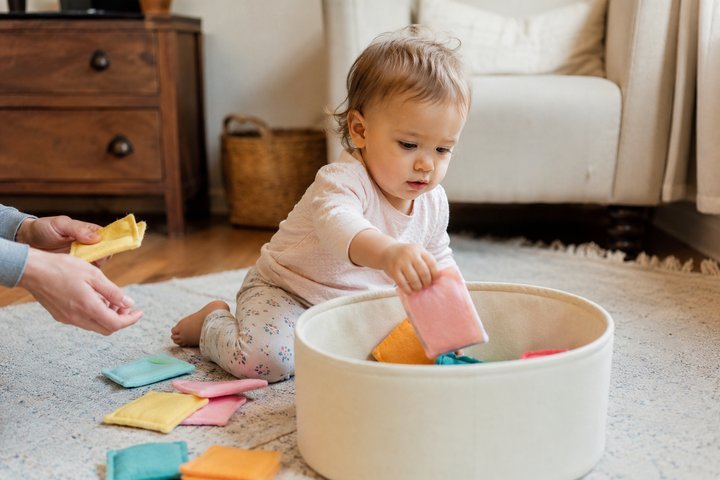
1. Sock drop
Tags: Busy solo · 5 min · No prep · Rainy day
You’ll need: Clean socks and a laundry basket or large bowl
What to do: Drop one sock into the basket so your child sees the idea. Hand over the rest. When the basket is full, tip everything out and start again.
What it’s building: Reaching, releasing objects on purpose, and learning where things go.
2. Washcloth pull box
Tags: Busy solo · 5 min · Rainy day
You’ll need: An empty tissue box and several washcloths or short fabric squares
What to do: Push the fabric loosely into the box and leave one corner sticking out. Your child pulls everything out. Stuff it back in together when they’re done.
What it’s building: Grip strength and using two hands together.
Safety: Keep the fabric pieces short so nothing can wrap around the neck.
3. Big-lid posting tub
Tags: Busy solo · 5 min · Rainy day
You’ll need: A wide container and several very large plastic jar lids
What to do: Drop a lid into the container. Hand your child another one. Once they’re all inside, let your child shake the tub and dump them back onto the floor.
What it’s building: Hand-eye coordination and learning to release an object at the right moment.
Safety: Every piece should be far too large to fit in your child’s mouth.
4. Tape tab peel
Tags: 5 min · Rainy day
You’ll need: Painter’s tape and a tray or smooth floor
What to do: Stick down a few short strips of painter’s tape. Fold over one corner of each strip so there’s an easy tab to grab. Show your child how to peel one, then let them work on the others while you’re right there.
What it’s building: Finger control and the small pinching movement used for picking things up.
Sensory, sound, and language play
5. Wooden spoon sound test
Tags: 5 min · No prep · Rainy day
You’ll need: A wooden spoon, plastic bowl, cardboard box, and upside-down pot
What to do: Tap the spoon once against each surface. Then hand it over. Most 1-year-olds figure out very quickly that the pot makes the best noise.
What it’s building: Listening, experimenting, and noticing that one action creates different results.
6. Dinner-time kitchen basket
Tags: Busy solo · 5 min · No prep · Rainy day
You’ll need: A basket, whisk, wooden spoon, plastic cup, and dish towel
What to do: Put the basket on the kitchen floor while you make dinner. Your child gets to empty it, bang the tools together, put things back, and carry them around. Don’t keep adding more stuff. Four or five objects is plenty.
What it’s building: Independent exploration, grip practice, and copying the everyday things they see you do.
7. Sealed squish bag
Tags: 5 min · Rainy day
You’ll need: A sturdy zip-top bag, water, and a little washable paint or mashed soft food
What to do: Put the filling inside the bag and seal it. Tape all four sides flat to a tray or the floor. Let your child press, poke, and swipe the mixture around. Check the bag before each use and throw it away if the plastic starts to weaken.
What it’s building: Finger strength and sensory exploration without a tray of loose material ending up underneath the fridge.
8. On-your-hip photo hunt
Tags: 5 min · No prep
You’ll need: Family photos displayed around the room
What to do: Carry your child over to a photo and point to one familiar face. Name the person. Move to another photo and do it again. Keep it short. Two or three pictures is enough.
What it’s building: Early language, recognition, and sharing attention with you.
Movement and cause-and-effect play
9. Cushion reach
Tags: 5 min · No prep · Rainy day
You’ll need: A firm couch cushion and a favorite toy
What to do: Put the cushion flat on the floor and place the toy just beyond it. Your child has to crawl across, lean over, or work around the cushion to get there. Stay close if they’re using the cushion to pull up.
What it’s building: Balance, core strength, and figuring out how to move around an obstacle.
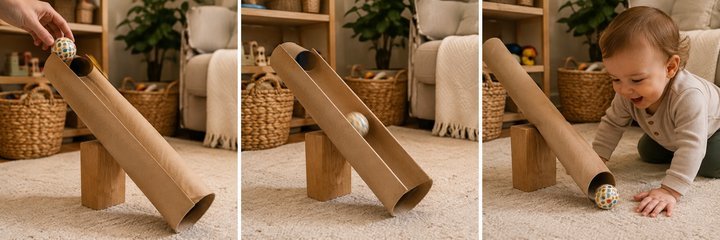
10. Tube roll and find
Tags: 5 min · Rainy day
You’ll need: A cardboard tube and a large ball or rolled-up sock
What to do: Prop the tube at a slight angle and drop the ball through. Point out where it comes out. Do it once more, then give your child the ball.
What it’s building: Tracking movement and understanding cause and effect.
If you only try one: Make the dinner-time kitchen basket. I’ve seen this hold attention longer than plenty of actual toys, and you can cook while they’re busy beside you.
Activities for late 1s: 18 to 23 months
Late 1s want to move and they want a job. Give them something to carry, push, wipe, stack, or pretend to do and you’re already halfway there.
Movement and real-life helping
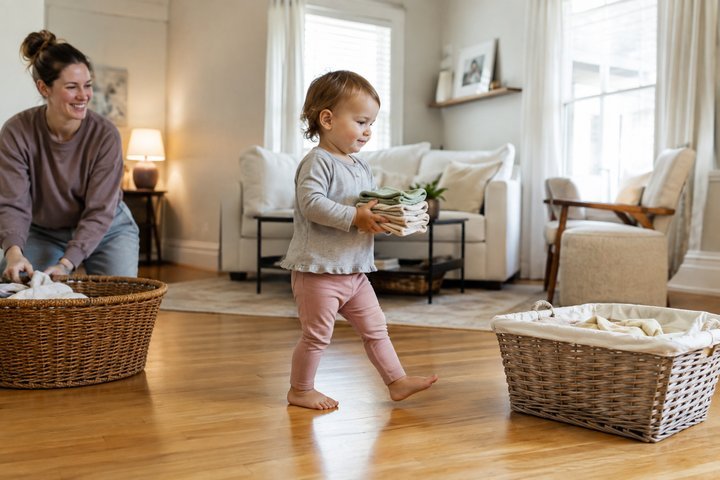
11. Laundry delivery route
Tags: Busy solo · 5 min · No prep · Burn energy
You’ll need: Two baskets and clean socks or washcloths
What to do: Put the baskets on opposite sides of the room. Show your child how to carry one sock from the first basket to the second. Then stop directing. The carrying is the activity.
What it’s building: Walking balance, carrying objects, and following a simple real-life job.
12. Painter’s tape road
Tags: Busy solo · 5 min · Rainy day
You’ll need: Painter’s tape and a large toy car, ball, or rolled sock
What to do: Make one wide line across the floor with painter’s tape. Push the toy along it once. Leave the toy at the beginning and let your child take over.
What it’s building: Hand control, visual tracking, and the beginning of pretend play.
13. Indoor broom ball
Tags: 5 min · Rainy day · Burn energy
You’ll need: A short-handled brush, soft ball, and clear floor space
What to do: Put the ball on the floor and show your child how to push it with the brush. A cardboard box on its side makes an easy goal. Move anything breakable first. This one gets enthusiastic fast.
What it’s building: Whole-body coordination and controlling the direction of an object.
14. Wipe the table
Tags: Busy solo · 5 min · No prep
You’ll need: A barely damp washcloth and a safe low surface
What to do: Wipe one part of the table. Hand your child the cloth and give them another section. Don’t fix their technique. The circles, smears, and repeated wiping are the play.
What it’s building: Imitation, arm control, and taking part in a real household task.
Pretend and problem-solving play
15. Stuffed-animal bedtime
Tags: Busy solo · 5 min · No prep · Rainy day
You’ll need: A stuffed animal, small towel, and box or basket
What to do: Put the stuffed animal into the box. Cover it with the towel and say goodnight. Then hand the whole setup over. At this age, bedtime can turn into feeding, carrying, hiding, or repeatedly throwing the animal out of bed.
What it’s building: Pretend play, sequencing, and language based on familiar routines.
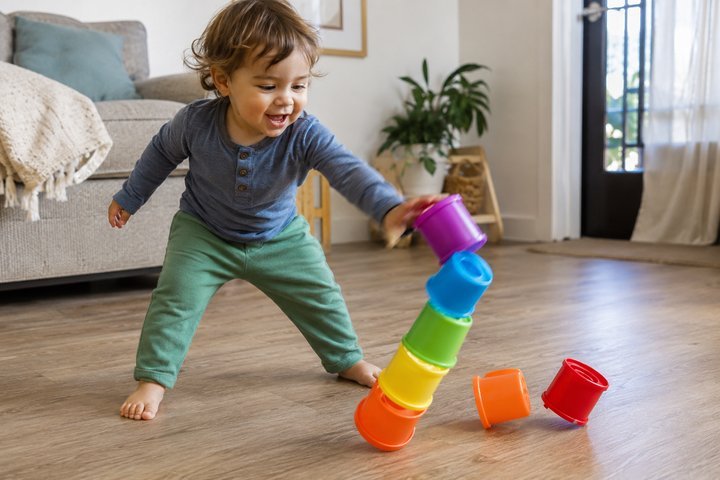
16. Cup tower crash
Tags: Busy solo · 5 min · Rainy day
You’ll need: Six plastic cups or food-storage containers
What to do: Stack two or three cups. Let your child knock them over. Put the cups back on the floor and leave them to stack, nest, carry, and knock them down again.
What it’s building: Hand-eye coordination, size awareness, and simple problem-solving.
17. Large-card posting box
Tags: Busy solo · 5 min · Rainy day
You’ll need: A cereal box with a wide slot and several large cardboard cards
What to do: Cut a wide slot into the box and cover rough edges with tape. Show your child how to push one card through. When all the cards disappear inside, open the box and put them back on the floor.
What it’s building: Precise hand movement, persistence, and understanding where an object goes after it disappears.
Safety: Make the cards much too large to fit in the mouth.
18. Pillow path
Tags: No prep · Rainy day · Burn energy
You’ll need: Two or three firm cushions or folded blankets
What to do: Put the cushions flat on the floor with small gaps between them. Let your child walk across the path while you stay beside them. Once that’s easy, change the spacing.
What it’s building: Balance, leg strength, and adjusting steps to different surfaces.
19. Match the lid
Tags: Busy solo · 5 min · Rainy day
You’ll need: Three large plastic food containers and their lids
What to do: Put the containers and lids on the floor. Match one lid slowly, then leave the rest. Don’t turn it into a quiz. Trying the wrong lid and changing it is the useful bit.
What it’s building: Comparing size and shape and using both hands together.
20. Plastic container drawer
Tags: Busy solo · Rainy day
You’ll need: A low drawer or basket filled with large plastic containers and lids
What to do: Give your child access to one small collection of plastic containers while you work nearby. Let them pull everything out, stack it, put lids on, take lids off, and pack it back in. This is one of the rare late-1s activities I’ve seen genuinely buy ten quiet minutes. The drawer will not look better afterward.
What it’s building: Problem-solving, matching, stacking, and independent play.
If you only try one: Do the laundry delivery route. Late 1s love having a real job, it burns off energy, and there is nothing to set up.
Activities that work at any point in the 1s
These five survive the whole year. Keep the setup simple for a newly 1-year-old, then add more words or pretend as they get closer to 2.
Sensory and quiet play
21. Shallow water play
Tags: 5 min · No prep
You’ll need: A shallow tray, a little water, and two plastic cups or spoons
What to do: Put the tray on a towel. Add just enough water for scooping and splashing, then hand over the cups. Stay within arm’s reach the whole time and empty the tray when you’re finished.
What it’s building: Sensory exploration, pouring control, and learning how water moves.
22. Board-book basket
Tags: Busy solo · No prep · Rainy day
You’ll need: Three to five sturdy board books in a low basket
What to do: Leave the books where your child can reach them. Let them choose, carry, open, close, and look through the same book five times. When they bring one to you, name a picture or read together.
What it’s building: Early language, page-turning control, and choosing what to explore.
Open-ended movement and copying
23. Cardboard box, no instructions
Tags: Busy solo · 5 min · No prep · Rainy day
You’ll need: A sturdy cardboard box with packing material, staples, and loose tape removed
What to do: Put the box on the floor. That’s it. I’ve seen boxes become drums, boats, beds, hiding places, containers, and things to push across the room. Giving no instructions is part of why it works.
What it’s building: Whole-body problem-solving and open-ended play.
24. Mirror copy game
Tags: 5 min · No prep · Rainy day
You’ll need: A sturdy, safe mirror
What to do: Sit together and do one simple action, like clapping or touching your head. Wait. When your child does something different, copy them back.
What it’s building: Imitation, body awareness, turn-taking, and early communication.
25. Window watch
Tags: No prep · Rainy day
You’ll need: A safe window view
What to do: Sit together and look outside. Point out one thing you can actually see: a dog, truck, bird, rain, tree, or person. Stay with whatever catches your child’s attention instead of turning it into a vocabulary lesson.
What it’s building: Observation, attention, and language connected to real things.
What do you actually need for 1-year-old play?
Not much.
A useful stash for this age is:
- Two or three containers in different sizes
- A low basket with safe kitchen tools, socks, or washcloths
- Painter’s tape
- A shallow tray or baking sheet
- A sturdy cardboard box
- A few board books
- Large, washable toys
Before putting household objects into play, check for sharp edges, loose pieces, button batteries, accessible magnets, and choking hazards.
Then stop adding things. A 1-year-old does not need a shelf that looks like a toy catalog.
Frequently asked questions
How long should activities last for a 1 year old?
Five to 10 minutes is a solid run for an activity with a 1-year-old. Plenty last less than that. If your child dumps the activity onto the floor after three minutes and moves on, the activity still worked.
Do 1 year olds need structured activities?
No. Free play, everyday routines, outdoor time, books, and tagging along while you get things done give a 1-year-old plenty to explore. Structured activities are useful when you need an idea to break up the day, not because your child needs a packed play schedule.
What activities help a 1 year old’s development?
Dumping and filling containers, posting large objects, stacking, carrying, climbing safely, looking at books, and copying everyday actions all build useful early skills. The ordinary stuff works because 1-year-olds want repetition more than novelty.
What can I do with a 1 year old who isn’t walking yet?
Start with seated container play, tape peeling, a sealed sensory bag, board books, mirror play, sock dropping, and a kitchen basket on the floor. The Early 1s section above is built for crawlers, cruisers, and brand-new walkers.
One good activity is enough
Pick the thing that fits the part of the day you’re in and keep it simple.
For more ideas across the toddler years, see toddler activities: 45 ideas by age. For a deeper collection of sensory play, go to sensory activities for 1 year olds.
You can also join the email list for the printable play pack.