
Sensory Play for 1 Year Olds (Sorted by Mess)
You see the perfect rainbow sensory bin online and have two immediate thoughts: I should probably do that, and my kid is absolutely going to eat it.
Then there’s the cleanup.
Sensory play for a 1-year-old does not need rainbow rice, twelve tiny scoops, or a dedicated craft room. It can be very simple.
So this page is sorted by the two things that actually stop parents doing it. Start with taste-safe if everything still goes in the mouth. Go to low-mess if cleanup is the bigger problem. Save the messy section for a day when you’ve got the energy.
What is sensory play, and does my 1 year old need fancy setups?
Sensory play just means exploring through the senses: touching, looking, listening, smelling, moving, and tasting.
Your 1-year-old already does this all day. They squash food between their fingers. Splash bath water. Rub the couch. Bang a spoon on the floor because apparently the first fourteen bangs didn’t answer the question.
You don’t need to improve this with a sensory kit.
Sit nearby. Name what they’re noticing. When they look at you or make a sound, answer them. That back-and-forth is sometimes called serve-and-return: your child does something, you respond, and they learn that their actions get a response.
And don’t force the setup. I’ve watched a 1-year-old touch a beautiful sensory tray with one finger, stare at the finger, and crawl away. The activity lasted six seconds. That’s still exploration.
What is safe for a 1-year-old who mouths everything?
At 1, assume materials are going toward the mouth.
My rule is simple: if it isn’t safe to mouth, it stays sealed or you stay right there and keep it out of the mouth.
Skip water beads entirely for a 1-year-old. The U.S. Consumer Product Safety Commission warns that swallowed water beads can expand inside the body and cause choking or intestinal blockage.
Dry rice, dry beans, small beads, and other tiny loose fillers are not taste-safe choices for this page either.
For food-based sensory play, use foods your child already eats safely. This is play, not the place to introduce a new food or work through feeding questions.
Now we can get to the fun part.
Taste-safe sensory activities for 1 year olds
These setups use familiar edible ingredients, so a curious lick doesn’t end the activity. Taste-safe does not mean “leave them to it.” You’re still sitting nearby because 1-year-olds remain impressively creative about finding trouble.
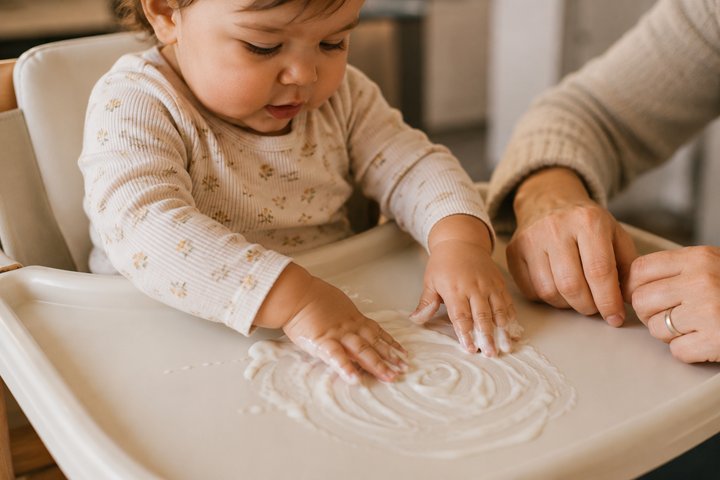
1. Yogurt finger paint
Tags: 5 min · No prep
You’ll need: A spoonful of plain yogurt and a high-chair tray or washable tray
What to do: Spread a thin layer of yogurt on the tray. Let your child swipe, pat, smear, and draw lines through it with their fingers.
Skip the paper. The tray is easier to clean and your child does not care about preserving the artwork.
Safety: Use only a familiar food your child already eats safely. Stay with them throughout the activity.
What it’s building: Exploring texture and noticing the marks their hands leave behind.
2. Cooked spaghetti tray
Tags: 5 min · Rainy day
You’ll need: A small amount of plain cooked spaghetti, fully cooled
What to do: Put a handful on a tray and let your child pull, squeeze, lift, drop, and move it around.
Do not cook an entire box for this. The amount that fits in two adult hands is more than enough to get into their hair.
Safety: Cool the pasta completely and use only familiar food. Supervise closely while your child explores.
What it’s building: Grip strength and exploring something slippery, stretchy, and soft.
3. Oatmeal squish
Tags: 5 min · No prep
You’ll need: A small amount of plain cooked oatmeal, cooled
What to do: Put a few spoonfuls on the tray. Let your child press a palm into it, make finger trails, scoop it, or push it into little piles.
A thin layer is plenty. Sensory play does not improve in proportion to how much oatmeal ends up on the floor.
Safety: Let the oatmeal cool completely and use only familiar food. Stay with your child.
What it’s building: Exploring a thick, sticky texture with hands and fingers.
4. Banana smash
Tags: 5 min · No prep
You’ll need: A small piece of ripe banana and a tray
What to do: Put the banana on the tray and flatten it once with your finger. Let your child squash, smear, pinch, and spread it.
If it turns into snack time, the sensory activity has made its own decision.
Safety: Use a familiar food and supervise throughout.
What it’s building: Finger pressure, hand control, and noticing how a soft material changes when squeezed.
5. Applesauce trails
Tags: 5 min · No prep
You’ll need: A spoonful of unsweetened applesauce and a tray
What to do: Make one small blob on the tray and drag a finger through it. Let your child take over.
Try circles, handprints, or just repeated smearing. There is no finished picture.
Safety: Use only a familiar food your child already eats safely and stay nearby.
What it’s building: Finger movement and noticing how a wet material moves across a smooth surface.
6. Cornstarch goop
Tags: 5 min · Rainy day
You’ll need: Cornstarch, water, a bowl, and a tray
What to do: Mix cornstarch with small amounts of water until it feels firm when squeezed and runny when released. Put a little on the tray and let your child press and scoop it with their hands.
This one feels strange enough that plenty of adults end up playing with it too.
Safety: Supervise closely and discourage eating it.
What it’s building: Exploring how one material can feel completely different depending on how it’s touched.
7. Taste-safe squish bag
Tags: 5 min · Rainy day
You’ll need: A sturdy zip-top bag, a spoonful of yogurt or mashed banana, and strong tape
What to do: Put the food inside, squeeze out excess air, seal the bag, and tape all four edges firmly to the tray. Let your child press, push, and move the filling around through the plastic.
The sensory part happens through the bag, so this also works for a child who hates sticky hands.
Safety: Stay beside your child and check the bag for tears before every use. Take it away immediately if the seal or plastic weakens.
What it’s building: Finger pressure and sensory exploration without direct contact with the messy material.
If you only try one: Do yogurt finger paint on the high-chair tray. One spoonful is enough, the setup takes ten seconds, and cleanup is mostly wiping down something you were going to wipe down anyway.
Low-mess sensory activities for when you can’t face cleanup
Sometimes the mess is the whole reason sensory play isn’t happening.
These keep the interesting part inside a bag, bottle, basket, or tray instead of distributing it across four rooms and the family dog.
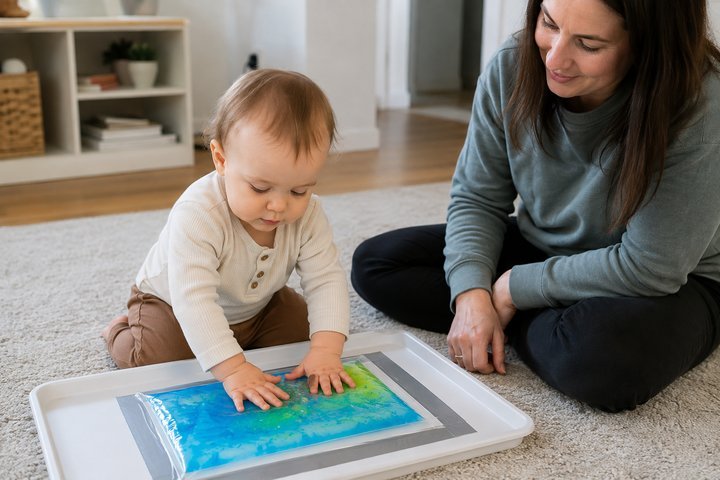
8. Sealed squish bag
Tags: 5 min · Rainy day
You’ll need: A sturdy zip-top bag, a little water, washable paint, and strong tape
What to do: Add a small amount of water and paint to the bag. Seal it, then tape all four edges firmly to a tray.
Your child presses, pats, and pushes the color around without touching the paint.
Safety: The contents are not for mouthing. Stay nearby, inspect the bag before use, and remove it immediately if the plastic or seal becomes damaged.
What it’s building: Hand pressure and watching color move in response to touch.
9. Oil-and-water sensory bottle
Tags: Busy solo · Rainy day
You’ll need: A clear plastic bottle with a screw lid, water, cooking oil, and tape
What to do: Put a little colored water and cooking oil in the bottle, leaving some empty space. Screw the lid on hard and secure the whole lid with strong tape.
Your child can turn, roll, and shake it while the liquids separate and come back together.
Safety: Seal the bottle completely and check it before every use. If the lid loosens, cracks, or leaks, throw the setup away. Keep your child in the same room even with the Busy solo tag.
What it’s building: Watching movement and noticing that two liquids behave differently when shaken.
10. Sticky-window shapes
Tags: 5 min · Rainy day
You’ll need: Clear contact paper, painter’s tape, and a few large pieces of fabric or paper
What to do: Tape a sheet of contact paper sticky-side-out to a low wall or window. Hand your child one large piece at a time to stick on and peel off.
Do not prepare thirty tiny shapes. Large scraps work better at this age anyway.
Safety: Supervise closely. Keep contact paper, backing paper, tape, and loose scraps out of the mouth.
What it’s building: Exploring sticky and smooth surfaces while practicing pulling and pressing.
11. Touch basket
Tags: 5 min · No prep · Rainy day
You’ll need: A basket with three large household objects with different textures
What to do: Try a silicone spatula, soft washcloth, wooden spoon, or large textured ball. Let your child handle one at a time.
You can name what they feel: smooth, soft, bumpy, hard.
Safety: Every object needs to be large, clean, sturdy, and free of detachable parts, batteries, magnets, sharp edges, and choking hazards. Supervise mouthing.
What it’s building: Comparing textures through ordinary household objects.
12. Barely-wet sponge tray
Tags: 5 min · No prep
You’ll need: A clean sponge, shallow tray, and a tiny amount of water
What to do: Wet the sponge and squeeze most of the water out before putting it on the tray. Let your child press it, pat it, and watch small amounts of water appear.
Re-wet it yourself if it dries out.
Safety: Water play requires constant, arm’s-reach supervision even when the amount is small. Empty and dry the tray immediately afterward.
What it’s building: Exploring wet versus dry and seeing how squeezing changes the sponge.
13. Texture footpath
Tags: No prep · Rainy day
You’ll need: A bath towel, smooth blanket, and textured floor mat
What to do: Put two or three different surfaces next to each other on the floor. Hold your child’s hands if needed and let them crawl or walk across them barefoot.
Stop and let them revisit whichever texture gets their attention.
Safety: Keep every surface flat and slip-resistant. Stay beside your child and remove anything they start pulling toward the mouth.
What it’s building: Feeling texture through the feet and adjusting movement across different surfaces.
14. Big-object treasure basket
Tags: 5 min · No prep · Rainy day
You’ll need: A low basket and four large safe household objects
What to do: Add things that feel or sound different: a silicone whisk, washcloth, wooden spoon, plastic cup, or large brush. Put the basket down and let your child decide what to inspect first.
The best treasure baskets look disappointingly ordinary to adults. That is part of why they work.
Safety: Use only large, sturdy objects with no loose pieces or choking hazards. Stay nearby because every object still gets the mouth test at this age.
What it’s building: Comparing weight, texture, shape, and sound through self-directed exploration.
If you only try one: Make the oil-and-water bottle. Once it’s properly sealed, there is nothing to scatter, smear, pour, or sweep up afterward.
Sensory play that’s worth the mess
Some sensory play is messy because the mess is the interesting part.
Save these for the high-chair tray, outside, right before bath time, or a day when seeing yogurt in somebody’s eyebrow will not break you.
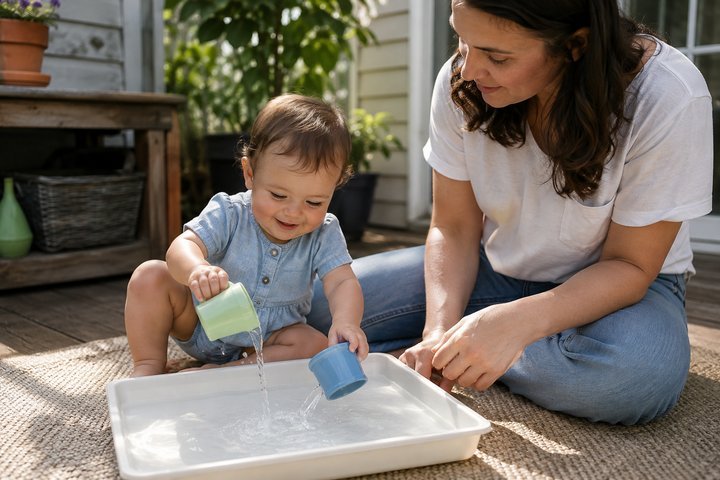
15. Cup-and-water splash
Tags: 5 min
You’ll need: A shallow tray, tiny amount of water, and two plastic cups
What to do: Put the tray on the floor or outside and add a shallow layer of water. Give your child the cups and let them scoop, tip, pat, and splash.
Easy-cleanup spot: Outside or on a towel right before bath time.
Safety: Stay within arm’s reach for every second of water play. Keep the amount small and empty the tray immediately when you’re done.
What it’s building: Exploring pouring, splashing, temperature, and how water moves.
16. Cooked-pasta sensory bin
Tags: 5 min · Rainy day
You’ll need: A deep tray, small amount of fully cooled cooked pasta, and a large plastic cup
What to do: Put the pasta in the tray and add one cup for scooping. Let your child grab, drop, squeeze, and move it between the tray and cup.
Do not fill a huge storage bin. The cleanup-to-play ratio turns against you very quickly.
Easy-cleanup spot: High-chair tray or kitchen floor on a washable mat.
Safety: Use only familiar food, cool it completely, and supervise throughout.
What it’s building: Gripping slippery materials and moving them between containers.
17. Full-hand yogurt painting
Tags: 5 min
You’ll need: Plain yogurt and a large washable tray
What to do: Spread a thin layer across the tray instead of making one small blob. Let your child use whole hands, fingertips, and palms to smear it around.
This is the bigger, messier cousin of the taste-safe setup above.
Easy-cleanup spot: High chair immediately before bath time.
Safety: Use only familiar food and supervise throughout.
What it’s building: Big hand movements and exploring a cool, slippery texture.
18. Whipped-yogurt foam
Tags: 5 min · Rainy day
You’ll need: Plain yogurt, a whisk, bowl, and tray
What to do: Whisk the yogurt until it’s a little lighter and spoon a small pile onto the tray. Let your child squash it, spread it, and make peaks with their fingers.
It does not need food coloring or six bowls. White foam is still foam.
Easy-cleanup spot: High-chair tray or washable kitchen floor.
Safety: Use only a familiar food your child already eats safely and stay beside them.
What it’s building: Exploring a soft texture that changes shape easily under the hands.
19. Mud kitchen, minus the kitchen
Tags: 5 min · Burn energy
You’ll need: Damp soil, one large plastic cup, and a spoon
What to do: Outside, make one small patch of damp mud and add the cup and spoon. Let your child pat, scoop, stir, and make marks.
You do not need a wooden mud kitchen with tiny labeled utensils. Dirt was managing this activity perfectly well before Pinterest arrived.
Easy-cleanup spot: Outside, preferably before bath time.
Safety: Stay close and stop the activity if your child is eating the soil. Check the area first for animal waste, sharp objects, mushrooms, chemicals, or other unsafe debris.
What it’s building: Exploring a heavy, sticky natural texture and changing it through scooping and pressing.
20. Big goop tray
Tags: 5 min · Rainy day
You’ll need: Cornstarch, water, and a large tray
What to do: Make a larger batch of the cornstarch-and-water mixture and spread it across the tray. Let your child grab it hard, release it, drag fingers through it, and watch it run back together.
I’ve done setups like this that held attention for fifteen minutes and took nearly as long to clean. This one earns its place, but choose your day.
Easy-cleanup spot: High-chair tray, washable kitchen floor, or outside.
Safety: Supervise closely and discourage eating it. Clean up when play ends.
What it’s building: Feeling how pressure changes the way the same material behaves.
If you only try one: Do the shallow water tray. Water is cheap, endlessly interesting at 1, and cleanup mostly involves accepting that the floor is now cleaner in one oddly specific patch.
How do you make sensory play easier to clean up?
Do not “embrace the mess.” Contain it.
Use the high-chair tray when the activity fits there. Put a bath towel or washable mat underneath before you start. Keep the amount of material small. Five spoonfuls of pasta gives the same sensory information as an entire stockpot.
For a genuinely messy setup, strip your child down to a diaper and do it before bath time. Keep a damp cloth beside you so you don’t have to carry a yogurt-covered toddler across the house looking for one.
And stop after five or ten minutes. You don’t get bonus points for keeping the tray alive after your child has moved on.
What do you actually need for sensory play?
Not a sensory kit.
A useful little stash is:
- A washable tray or baking sheet
- A couple of sturdy zip-top bags
- Strong tape
- A clear plastic bottle with a secure lid
- A low basket or deep tray
- Plastic cups
- A sponge
- Large textured household objects
- Familiar kitchen staples such as cooked oats, pasta, yogurt, and cornstarch
- A baby-safe mirror if you already have one
That’s plenty.
Skip water beads. Skip tiny decorative fillers. Skip the $60 coordinated sensory bin containing objects your 1-year-old is going to try to eat.
You already own the useful stuff.
Frequently asked questions
What sensory activities are safe for a 1 year old who puts everything in their mouth?
Use familiar taste-safe materials such as cooled cooked pasta, cooked oatmeal, yogurt, or mashed banana, or keep non-food materials completely sealed inside a sturdy sensory bag or bottle.
Avoid water beads, dry rice, dry beans, small beads, and other tiny loose fillers for a child who still mouths materials. Water beads are especially concerning because they can expand after swallowing and cause serious internal injury.
Are water beads safe for 1 year olds?
No. Skip water beads for a 1-year-old.
The CPSC estimates that about 6,300 water bead-related ingestion injuries were treated in U.S. emergency departments from 2017 to 2022. At least one death was reported, involving a 10-month-old girl in 2023. Water beads can expand after they’re swallowed and cause choking or intestinal blockage.
How do I do sensory play without the mess?
Use sealed sensory bags or bottles, a high-chair tray, a shallow contained setup, or a basket of large textured household objects.
Keep the quantity small. A spoonful of sensory material gives a 1-year-old plenty to explore without requiring you to hose down the room afterward.
How long should sensory play last for a 1 year old?
Five to 10 minutes is plenty for sensory play with a 1-year-old.
If your child pokes the material once and leaves, let them leave. Sensory play is an invitation to explore, not an assignment they have to finish.
Match the sensory play to the day
Sensory play gets much easier when you pick the setup based on what you can handle that day: taste-safe, contained, or properly messy.
For more everyday ideas, see activities for 1 year olds. For the full toddler activity guide, go to toddler activities: 45 ideas by age. If your child isn’t 1 yet, start with baby activities month by month.
You can also join the email list for the printable play pack.