
Low-stimulation shows for toddlers: 25 calm picks by age, and how to spot an overstimulating one
Sometimes the show ends and your toddler falls apart. Other times they seem wired afterward, can’t move on to playing, or spend the next hour asking for one more episode. That doesn’t mean you’ve failed by turning on the TV. It may just mean that particular show is too much for your child right now. This guide gives you low stimulation shows for toddlers, babies, and older kids, sorted by age, plus a simple way to judge any show that isn’t on the list.
What actually makes a show low stimulation?
There isn’t an official label on the screen that tells you a show is calm. You have to look at how it feels.
A low-stimulation show usually has:
Slow pacing: Scenes have time to breathe instead of changing every few seconds.
Softer colors: The screen isn’t constantly flashing with bright neon backgrounds.
Calm voices: Characters speak clearly and at a natural speed.
Simple stories: One small problem is introduced, worked through, and finished.
Repetition: Familiar openings, phrases, places, and routines help your child know what is coming.
The American Academy of Pediatrics has long advised families to avoid fast-paced programming for young children because they may not understand it as well. A small 2011 experiment also found short-term differences in 4-year-olds’ executive-function performance immediately after they watched a very fast cartoon. That does not prove that one episode causes lasting harm, and the study looked at an immediate effect in a small group, not long-term development. Read the study in Pediatrics.
What is the turn-off test?
The easiest way to judge a show is to watch what happens when it ends.
With a calmer show, your child may look up, wander away, or start playing while it is still running. With a show that is too gripping for them, they may sit rigidly, seem unable to look away, and melt down every time you turn it off.
One bad ending does not prove anything. Hunger, tiredness, and being three years old can also ruin an otherwise reasonable transition. But if the same show causes the same battle repeatedly, treat that as useful information.
Which show should I choose if I only need one?
Under 2: BeddyByes, especially for winding down.
Ages 2–4: Trash Truck, for a gentle story that still holds attention.
Ages 4–7: Stillwater, for calm stories with enough depth for an older child.
Calm shows for babies and young toddlers under 2
Common guidance says babies under 18 months learn best through real-world interaction rather than regular entertainment media. This section is mainly for families who choose to introduce a little high-quality, co-viewed screen time around 18 to 24 months, or who need something gentle during travel, illness, nail trimming, or another difficult moment. Read the AAP’s current guidance for families.
Streaming catalogs and video libraries change, so check availability in your region before promising a specific show to a toddler. They have long memories when contractual streaming rights disappoint them.
BeddyByes {#show-beddybyes}
Where to watch: Disney+ subscription and Disney Jr.
Age fit: Around 18 months to 3 years. Best for quiet time or the start of a bedtime routine.
Why it’s calm: The series was deliberately created around soothing journeys and daily routines. Its gentle music, simple movement, and bedtime structure make it one of the clearest true wind-down picks on this list.
An Anita note: This is the one I’d try when you need the screen to lower the temperature in the room, not raise it. I still wouldn’t make the TV the final step before sleep every night, but it works well when everyone needs to come down a level.
Puffin Rock {#show-puffin-rock}
Where to watch: Netflix subscription.
Age fit: Around 18 months to 4 years. Good for quiet mornings, sick days, and pre-nap slowing down.
Why it’s calm: The nature setting, soft landscapes, warm narration, and small everyday adventures leave space between events. Nothing seems desperate to retain your child’s attention.
An Anita note: This is one of the shows where I’ve seen kids watch for a minute, then start playing beside it. That is a good sign. The show can stay in the room without owning the entire room.
Sea of Love {#show-sea-of-love}
Where to watch: Netflix subscription.
Age fit: Around 18 months to 3 years. Useful when you want short, self-contained stories.
Why it’s calm: Episodes focus on small friendship problems and everyday experiences in an underwater setting. The stories are short, the voices are gentle, and the plot usually stays easy to follow.
Moon and Me {#show-moon-and-me}
Where to watch: Free full episodes and compilations on the official Moon and Me YouTube channel. In the UK, it may also be available through CBeebies or Sky services.
Age fit: Babies and young toddlers, especially as an evening wind-down.
Why it’s calm: The toy-house setting, bedtime feeling, repeated routines, and slow character movement make it feel closer to a quiet puppet story than a modern attention-grabbing cartoon.
An Anita note: Some adults find it a little strange. That is fair. Toddlers accept a moon visitor entering a toy house with far fewer questions than we do. The repetition is exactly why it works for many younger viewers.
Miffy’s Adventures Big and Small {#show-miffy}
Where to watch: Free full episodes and compilations on the official Miffy YouTube channel. Sky Kids and NOW may also carry it in the UK.
Age fit: Around 18 months to 3 years. Good for a very short screen session.
Why it’s calm: The animation uses simple shapes, uncluttered backgrounds, and straightforward everyday stories. Episodes are easy to enter and easy to leave because there is not a large dramatic hook carrying into the next one.
Guess How Much I Love You {#show-guess-how-much}
Where to watch: Prime Video or the Kidstream channel in supported regions.
Age fit: Around 18 months to 4 years. A good cuddle-on-the-couch choice.
Why it’s calm: The watercolor-style woodland setting and affectionate parent-child stories move gently. There is usually one simple question or discovery rather than a series of escalating problems.
In the Night Garden {#show-night-garden}
Where to watch: Free full episodes and compilations on the official In the Night Garden YouTube channel. In the UK, it is also available through CBeebies and BBC iPlayer.
Age fit: Babies and young toddlers. Best for familiar, repetitive viewing.
Why it’s calm: The show repeats names, movements, songs, and the same closing routine. It is colorful, but it rarely feels hurried.
An Anita note: This one is more dreamlike than educational. I use it when the job is simply “everybody sit quietly for a few minutes,” not when I’m hoping for a lesson on numbers or emotional vocabulary.
For more detail on this age group, including the common screen guidance for babies, visit low-stimulation shows for babies.
Calm shows for toddlers ages 2–4
This is the age when many parents first notice a real difference between shows. One leaves the child chatting and playing. Another ends with a demand for seventeen more episodes and a negotiation nobody remembers agreeing to.
Trash Truck {#show-trash-truck}
Where to watch: Netflix subscription.
Age fit: Ages 2–4. A reliable general-purpose pick for quiet playtime or when you need to finish something nearby.
Why it’s calm: The outdoor settings, warm animation, small cast, and imaginative but uncomplicated stories move without frantic editing. Episodes feel complete rather than like bait for the next one.
An Anita note: This is my safest first recommendation for a toddler who rejects shows that are too slow but gets wound up by louder ones. It holds attention without shouting for it.
Daniel Tiger’s Neighborhood {#show-daniel-tiger}
Where to watch: Free through PBS KIDS in the US, including the PBS KIDS Video app. Other services vary by region.
Age fit: Ages 2–5. Especially useful before a new experience or during a phase involving big feelings.
Why it’s calm: Episodes use predictable neighborhood routines, clear emotional problems, and repeated songs that help explain what the characters are practicing. There is music, but the story stays understandable.
An Anita note: I reach for Daniel Tiger when the episode matches something already happening at home, like waiting, sharing, saying goodbye, or trying again. The songs work better when you reuse the idea later instead of expecting the screen to perform all known parenting duties.
Bluey {#show-bluey}
Where to watch: Disney+ subscription, with some clips available through official Disney services.
Age fit: Ages 2–7. Strong for imaginative play and family viewing.
Why it’s calm: Many episodes focus closely on one family game or emotional moment, and the seven-minute format creates a natural stopping point.
An Anita note: Bluey is gentle, but it is not sleepy. Some episodes have quick play, shouting, chase scenes, or emotional tension. I’d call it thoughtful and manageable rather than universally low stimulation. Choose a familiar quieter episode if your child is already tired.
Bear in the Big Blue House {#show-bear-blue-house}
Where to watch: Disney+ subscription.
Age fit: Ages 2–5. Good for children who respond better to puppets and real voices than bright animation.
Why it’s calm: Bear speaks directly but naturally, scenes last long enough to follow, and songs sit inside simple stories about cooperation, routines, and everyday experiences.
Tumble Leaf {#show-tumble-leaf}
Where to watch: Prime Video in supported regions. Availability varies more than most Amazon titles, so check before relying on it.
Age fit: Ages 2–5. Good for curious toddlers who like building, testing, and figuring things out.
Why it’s calm: The stop-motion world moves gently and focuses on one object, question, or discovery at a time. The show invites play rather than replacing it.
An Anita note: I like this one when I want the screen to lead back into an activity. A child may watch Fig test something and then start building with cups, cardboard, or blocks. That is a much easier transition than dragging them away from a cliffhanger.
Not Quite Narwhal {#show-not-quite-narwhal}
Where to watch: Netflix subscription.
Age fit: Ages 2–5. Good for children who want magic and music without constant commotion.
Why it’s calm: The show uses soft ocean and pastel fantasy settings, friendly voices, and stories about identity, family, and belonging. It is more musical than Puffin Rock or Trash Truck, but it does not usually pile several sounds and actions on top of each other.
Elinor Wonders Why {#show-elinor}
Where to watch: Free through PBS KIDS in the US.
Age fit: Ages 3–6. Good for the child who asks a new question before you have finished answering the previous one.
Why it’s calm: Each story stays with one observation about animals, plants, sound, weather, or daily life. Characters pause to look, ask questions, and test ideas rather than racing from problem to problem.
Oswald {#show-oswald}
Where to watch: Paramount+ subscription in supported regions.
Age fit: Ages 2–5. Good for a slower afternoon or when a child is recovering from a busy day.
Why it’s calm: Oswald speaks gently, Big City is friendly rather than chaotic, and the stories revolve around ordinary events such as a sleepover, a dripping faucet, or planning a tea party.
An Anita note: This is the show I recommend to parents who say, “My child refuses anything that looks too babyish, but the modern shows are too much.” It has enough story to hold them without adding an alarm every twelve seconds.
Little Bear {#show-little-bear}
Where to watch: Paramount+, Prime Video, Tubi, or other services in some countries. It is not available everywhere, so check your region.
Age fit: Ages 2–5. Good for cozy mornings and quiet play beside the TV.
Why it’s calm: The older animation uses longer scenes, natural conversation, soft woodland colors, and small stories about family and friends. It does not behave as though every pause is an emergency.
An Anita note: A child used to very fast shows may walk away from Little Bear at first. That is not necessarily a failure. Sometimes “they started playing instead” is exactly the outcome you wanted.
JoJo & Gran Gran {#show-jojo-gran-gran}
Where to watch: Free videos, compilations, and selected full episodes on the official JoJo & Gran Gran YouTube channel. In the UK, the full series is also available through CBeebies and BBC iPlayer.
Age fit: Ages 3–5. Good for real-world family stories without much fantasy or noise.
Why it’s calm: JoJo and her grandmother spend time doing ordinary things, visiting places, observing the seasons, and working through small problems together. The affectionate relationship carries the episode instead of visual effects.
Calm shows for preschoolers and older kids ages 4–7
Older kids can follow a longer story without needing constant cuts and songs. The best calm shows for preschoolers give them more to think about while still leaving room for a quiet nervous system.
Stillwater {#show-stillwater}
Where to watch: Apple TV+ subscription.
Age fit: Ages 4–7. Especially good after school, during a difficult emotional phase, or when the whole house needs to slow down.
Why it’s calm: The stories use quiet settings, natural pauses, and a wise panda who helps children look at everyday problems from another angle. The emotional lesson unfolds instead of being announced over loud music.
An Anita note: This would be my first pick for an older child who says they are “not tired” while behaving like a person who has been awake since the invention of electricity. It respects them without winding them up.
Frog and Toad {#show-frog-toad}
Where to watch: Apple TV+ subscription.
Age fit: Ages 4–7. Great for children who like book-based stories and quiet humor.
Why it’s calm: The show keeps the gentle rhythm of the original books. Each story stays with a friendship problem, small adventure, or ordinary misunderstanding and lets the characters talk it through.
An Anita note: Frog and Toad disagree and worry, but the show never makes conflict feel enormous. It is one of the few children’s series where losing a list can be the entire problem, which is honestly refreshing.
Carl the Collector {#show-carl-collector}
Where to watch: Free through PBS KIDS in the US.
Age fit: Ages 4–7. Good for children who enjoy collections, routines, detailed interests, and friendship stories.
Why it’s calm: Episodes focus on ordinary social situations and give characters time to explain what they need. The pacing is cozy, although the stories still have enough humor and movement for an older child.
An Anita note: This one is especially good for a child who notices details adults miss or wants to talk at length about one very specific interest. The show treats that enthusiasm as part of the child, not a problem to remove.
Mister Rogers’ Neighborhood {#show-mister-rogers}
Where to watch: Free episodes and clips through PBS KIDS in the US. Additional availability varies.
Age fit: Ages 3–7. Good for quiet one-to-one viewing with a parent nearby.
Why it’s calm: Mister Rogers speaks slowly, looks directly at the viewer, repeats important ideas, and spends real time watching ordinary processes such as how things are made. Nothing is rushed.
An Anita note: Some children take to it immediately. Others need time because it feels completely different from modern TV. Try one short segment first rather than presenting a full episode as a cultural obligation.
The Adventures of Paddington {#show-paddington}
Where to watch: Paramount+ subscription in supported regions.
Age fit: Ages 4–7. Good when your child wants a fuller story but still needs warmth and predictability.
Why it’s calm: Paddington’s adventures are built around curiosity, kindness, small mistakes, and everyday lessons. There is more movement and comedy than in Stillwater, but the stories remain clear and affectionate.
An Anita note: I would not use this as the sleepiest pick on the list. It is better for a calm afternoon than the final fifteen minutes before bed.
Molly of Denali {#show-molly-denali}
Where to watch: Free through PBS KIDS in the US.
Age fit: Ages 5–7. Best for children ready for longer stories involving nature, family, culture, and problem-solving.
Why it’s calm: Episodes have more plot than the toddler picks, but the storytelling is steady and grounded in real places and relationships. The show gives children time to observe, investigate, and understand what is happening.
Franklin {#show-franklin}
Where to watch: Prime Video for purchase or through supported channel subscriptions in some regions.
Age fit: Ages 4–7. Good for everyday social problems such as fear, jealousy, fairness, and friendship.
Why it’s calm: Franklin’s world has muted woodland colors, familiar characters, and stories that develop at a patient pace. There may be a disagreement or worry, but the show does not turn every feeling into a crisis.
An Anita note: The older hand-drawn Franklin is generally calmer than the newer computer-animated Franklin and Friends. Both can work, but they do not feel exactly the same.
Sarah & Duck {#show-sarah-duck}
Where to watch: Free episodes and compilations on the official Sarah & Duck YouTube channel. The official Sarah & Duck website also features a rotating episode and clips. In the UK, it may also be available through CBeebies and BBC iPlayer.
Age fit: Ages 3–7. Good for children who like gentle nonsense and unusual little ideas.
Why it’s calm: Episodes are short and unhurried, with soft visuals, dry narration, and stories that follow a child’s imagination without turning it into a loud spectacle.
An Anita note: It is odd in the best way. A scarf can have a social life and a rainbow can need help, but the show remains calmer than many programs about entirely normal events.
What unexpected things can work better than a kids’ show?
Sometimes the calmest screen is not a show at all.
An aquarium live cam gives your child something real to watch without a plot demanding that they reach the ending. Jellyfish drift, fish pass through kelp, and sometimes very little happens. The Monterey Bay Aquarium offers several free live cams, including jellyfish, sea otters, open-ocean, and kelp-forest views.
Live nature cams can work the same way. Explore.org carries free cameras showing wildlife, nests, watering holes, oceans, and sanctuaries. Preview the feed first because nature does not consult the preschool content guidelines before behaving like nature.
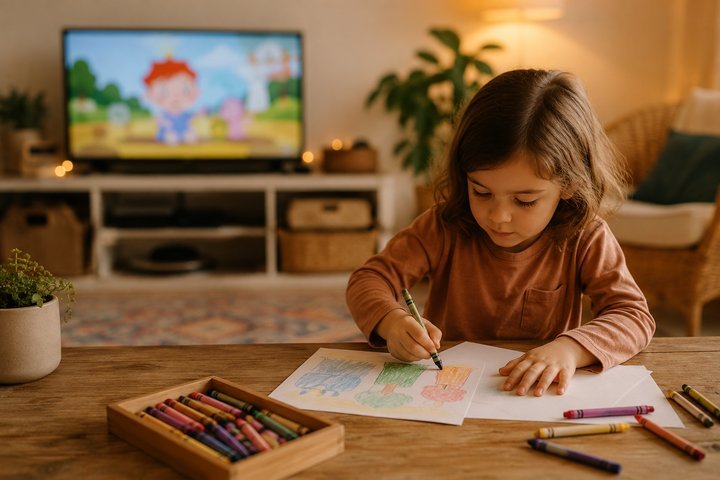
Gentle painting videos are another good option. A Bob Ross episode has a steady camera, one calm voice, and a process your child can copy with paper and crayons. Full episodes are available free through the verified Bob Ross YouTube channel.
Slow real-world videos can also work, such as a steady walk through a rainy town, a train ride, or somebody quietly making bread. Turn autoplay off and preview the video first. The lack of a cliffhanger is the useful part. When nothing urgent is about to happen, there is less to fight about when you stop.
Which shows do some parents deliberately avoid?
Some families avoid or tightly limit shows such as CoComelon, Little Baby Bum, Blippi, and Paw Patrol because they combine more frequent scene changes, bright colors, constant music, excited speech, alarms, vehicles, or rapidly escalating action.
That does not make those shows universally bad, and it does not mean every child will react badly. It means they sit at the opposite end of the calm-TV framework.
CoComelon, for example, has been reported to use shots that frequently change every one to three seconds, often with movement tied to the music. That explains why it feels very different from a long, quiet scene in Little Bear or Mister Rogers, but it does not prove that watching CoComelon causes lasting developmental harm. The AAP also says there is no research showing that CoComelon itself has either a positive or negative effect on toddler development. Read the AAP’s CoComelon guidance.
Ms. Rachel needs a more nuanced answer. Her videos include music, movement, and long compilations, so some children become intensely attached and struggle when they end. That can make them a poor fit when your goal is a passive wind-down.
At the same time, the American Academy of Pediatrics notes that her approach includes clear learning goals, simple language, deliberate pauses for children to respond, and encouragement for parents to join in. The AAP also says there is no published research showing that Ms. Rachel videos themselves improve a child’s speech. She can model useful interaction, but she is not a replacement for talking with your child, an evaluation, or speech therapy when it is needed. Read the AAP Center of Excellence guidance on Ms. Rachel.
The fair test is not whether the internet has placed a show on a good list or a bad list. Watch your own child. Can they look away? Can they move on? Do they seem calmer, the same, or more frantic afterward?
How can you use screens without the guilt?
Reaching for the TV because you need to make dinner, handle a sick day, take a shower, or sit down for fifteen minutes is not a moral failure. It is a household tool. The goal is to use it thoughtfully rather than pretending you will achieve perfect screen purity in a home containing actual humans.
When you can, sit nearby for part of the episode. Point to something, name what is happening, or connect it to real life. Young children learn more from media when an adult helps them understand and use what they see.
Short sessions are also easier to end. One 15- or 20-minute episode with a clear finish is usually simpler than autoplay quietly building a small television empire in your living room.
The AAP’s 2026 guidance moves beyond treating one time limit as the whole answer. It asks families to consider the 5 Cs: your individual Child, the Content, whether screens are being used to Calm, what media may be Crowding Out, and ongoing Communication. Read the AAP’s 5 Cs framework. The AAP’s current family guidance similarly emphasizes quality, context, conversation, sleep, play, movement, and how the child responds. Read the 2026 policy explanation.
Its longstanding age-based guidance remains a useful starting point: avoid regular entertainment media under about 18 months, except video calls; co-view high-quality content if introducing it from 18 to 24 months; and aim for about one hour or less of high-quality programming per day for ages 2–5. Read the AAP’s age-based guidance in Media and Young Minds.
You do not need to hit the recommendation perfectly every day. You need a pattern that leaves room for sleep, movement, books, conversation, boredom, and play.
Frequently asked questions
What are the best low-stimulation shows for toddlers?
Good starting choices include Puffin Rock, Trash Truck, Daniel Tiger’s Neighborhood, Bear in the Big Blue House, Tumble Leaf, and Little Bear. The best pick is the one your child can enjoy and then leave without becoming distressed every time it ends.
Is CoComelon overstimulating?
CoComelon uses frequent cuts, bright colors, near-constant music, and repeated movement, so it is more stimulating than shows such as Puffin Rock or Little Bear. That does not prove it is harmful, but it may be a poor choice for a child who becomes fixated, wired, or consistently melts down when it ends.
What makes a show overstimulating?
Common signs include rapid scene changes, bright or flashing visuals, several sounds playing at once, excited or unnatural speech, constant music, and stories that never pause. Your child’s reaction matters too. If they cannot look away or transition after nearly every viewing, choose a slower show or a shorter session.
Are there low-stimulation shows on Netflix and Disney+?
Netflix has calmer options including Puffin Rock, Sea of Love, Trash Truck, and Not Quite Narwhal. Disney+ has BeddyByes, Bear in the Big Blue House, and Bluey, although some Bluey episodes are more energetic than others. Availability changes by region, so check your local catalog.
How much screen time is okay for a toddler?
Common age-based guidance says to avoid regular entertainment media for babies younger than about 18 months, except video calls. From 18 to 24 months, choose high-quality content and watch together if you introduce screens. For ages 2–5, the AAP’s longstanding guidance suggests about one hour or less per day, while its newer guidance also emphasizes the individual child, content, context, calming, communication, and what screen use replaces.
How do I stop the meltdown when a show ends?
Choose one short episode, tell your child the limit before it starts, and turn autoplay off. Give a simple warning near the end and have the next activity ready, such as a snack, bath, book, or going outside. If the same show triggers a meltdown nearly every time, try a calmer show or take a break from it.
Related posts
Low-stimulation shows for babies
Best educational YouTube channels for kids
The babies guide goes deeper into the under-2 age range. The toddler activities hub is there for the days when you want a screen-free option and have enough functioning brain cells left to set one up.